
Rewriting the Routine: Meet the Founders Behind Everist
What happens when two beauty insiders rethink everything? Meet the founders of Everist, and the idea that changed how we see haircare.
Some brands begin with inspiration. Others begin with a gap in the market. But Everist began somewhere quieter, somewhere more personal.
It began with a question that lingered long after the workday ended, long after years spent inside the beauty industry had already taught Jayme Jenkins and Jessica Stevenson how everything was supposed to be done. What if the way we were making beauty products wasn’t the only way? And what if, hidden inside all that familiarity, was an opportunity to completely rethink the system itself?
Both founders came from within the industry, carrying more than two decades of combined experience working across global beauty companies. They understood formulation, packaging, branding, the entire machinery that brings a product to shelf. But they also saw what most consumers don’t see as clearly: the accumulation of waste, the default reliance on single-use plastics, and the way convenience often quietly outweighed intention. Over time, those observations stopped feeling like background noise and started feeling like something harder to ignore. Not a problem to work around, but a system to question.
That questioning eventually became Everist.
In the beginning, there was no clear roadmap, no polished concept waiting to be executed. Just an idea forming slowly around a simple but radical premise: what if beauty didn’t need to rely on water the way it always had? As the founders explored further, they discovered that most traditional shampoo formulas are made up of over 70% water, a realization that reframed everything. If water was already the primary ingredient, what would happen if it was removed entirely? What would be left, and could that “leftover” actually be better?
That question set everything in motion. What followed was nearly two years of research, testing, and rebuilding from the ground up. Instead of reformulating within the existing system, they stepped outside of it entirely, creating concentrated, waterless haircare that would later be activated in the shower. The shift sounds simple when described in hindsight, but at the time it meant rethinking not just the formula, but the format itself—how a product lives in the hand, how it travels through daily ritual, how it moves from concept to use.
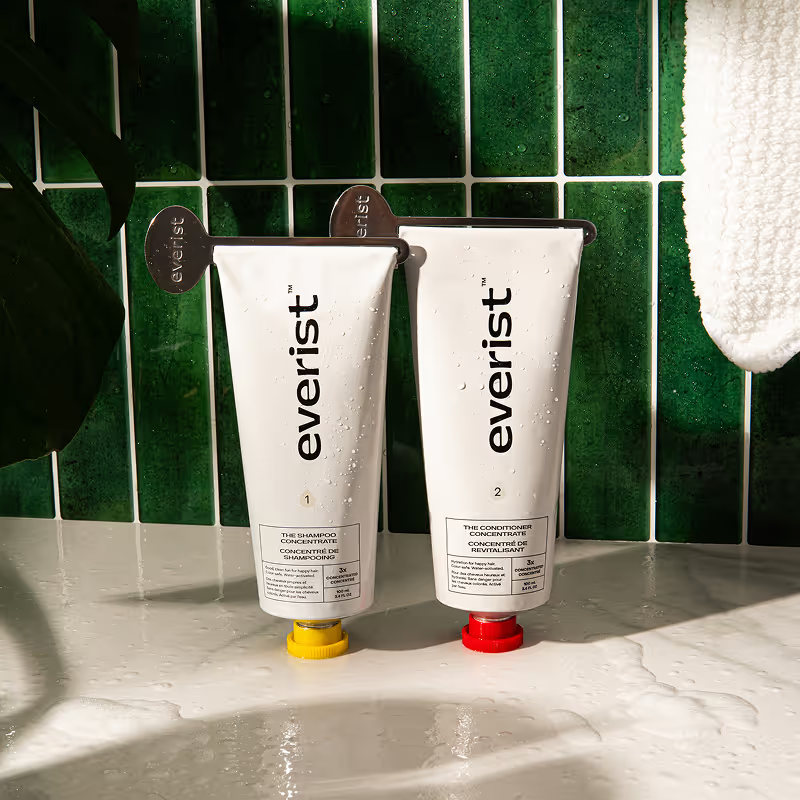
The result became Everist: a line of waterless concentrates housed in recyclable aluminum tubes, designed to eliminate unnecessary plastic while still delivering performance-driven results. It was beauty, but stripped back to its most intentional form. Nothing extra for the sake of habit. Nothing hidden behind tradition. Just function, reimagined through a more sustainable lens.
Everist
Everist's first-of-their-kind, 20x award-winning hair and body concentrates are hair and body care meets skincare.
Shop EveristBut what makes Everist feel distinct is not only the innovation itself, it’s the philosophy behind it. Jayme and Jessica have never positioned the brand as an exercise in perfection or purity. Instead, they often speak to a different kind of consumer: the “imperfect environmentalist.” The person who cares, who is trying, but who also lives in the reality of modern life where sustainability is rarely absolute and always evolving.
As they shared in Forbes, the intention was never to create a brand that demanded perfection, but one that made better choices feel more accessible, more realistic, and more integrated into everyday life. It’s a perspective that removes pressure rather than adding it, and in doing so, creates space for participation instead of paralysis.
That idea “participation over perfection” runs through everything Everist does. It shows up in the textures of the products, in the simplicity of the packaging, and in the way the brand quietly challenges the assumption that beauty routines need to be complicated to be effective. There is a softness to the innovation, a sense that change doesn’t need to arrive loudly to be meaningful.
Today, Everist stands as one of the most recognized examples of what happens when industry knowledge meets creative disruption. It has been celebrated for its innovation and named among leading beauty inventions, but the essence of the brand remains grounded in something much more understated. A belief that systems can be rebuilt. That rituals can be lighter. That beauty can evolve without losing its intimacy.
And at the center of it all are two founders who didn’t set out to reinvent an industry, but ended up doing exactly that by asking a better question.
Explore more founder-led Canadian beauty brands athttps://www.shopcanadianbeauty.ca/directory